
Originally Posted On: https://www.scn2afoundation.org/post/scn2a-crispr-activation
SCN2A CRISPR Activation: Which Variants It Could Help
A child with an SCN2A-related disorder has two copies of the SCN2A gene. The variant usually sits on one copy, and the other copy is typical.
CRISPR activation targets that second copy. It does not repair the variant. It tells the cell to read the gene more often, so the cell makes more of the protein it lacks.
In September 2025, Serena Tamura, Andrew Nelson, and Perry Spratt, with Nadav Ahituv and Kevin Bender at the University of California, San Francisco, published results in Nature showing this works in mice with SCN2A haploinsufficiency. The approach only fits variants where the affected copy produces nothing usable.
What Is CRISPR Activation?
Genes are instructions. To use one, a cell has to read it and build the protein it describes. The more often a cell reads a gene, the more of that protein it makes.
Every gene has an on switch sitting next to it, a short stretch of DNA called a promoter. That is where the cell’s reading machinery attaches.
Most CRISPR tools cut DNA. A protein called Cas9 carries a guide molecule that works like an address, and Cas9 travels to that address and cuts.
CRISPR activation uses a Cas9 that has been changed so it cannot cut. Scientists call it dead Cas9, or dCas9. It still travels to the address and holds on there, but it leaves the DNA alone. Researchers first showed in 2013 that a disabled Cas9 could control gene activity instead of cutting DNA.
Attached to it is a second protein called an activator. Its job is to call in the cell’s reading machinery.
Put those pieces together, and you get the treatment. The guide takes dead Cas9 to the SCN2A promoter. Dead Cas9 holds it there. The activator waves the reading machinery in. The cell reads SCN2A more often and makes more NaV1.2 protein.
It Does Not Change the DNA
CRISPR activation does not correct, remove, or rewrite the gene. Dead Cas9 sits on the DNA without altering a single letter.
What changes is how often the cell reads the gene, and therefore how much NaV1.2 protein the cell builds.
Other technologies do rewrite DNA letters, and they work on a different set of variants. We cover those in our guides to SCN2A base editing and SCN2A prime editing.
Why Turning the Gene Up Makes Sense in Loss of Function
Brain cells run on electricity. To send a signal, a cell opens tiny gates in its outer surface and lets sodium rush in. Those gates are called sodium channels, and SCN2A carries the instructions for building one of them, NaV1.2, which is found throughout the central nervous system. Our guide to how the SCN2A gene builds the NaV1.2 channel covers this in more detail.
A child has two copies of SCN2A, and both are meant to be producing NaV1.2. In a loss-of-function variant, one copy stops producing a usable protein. The remaining copy keeps working, but one copy doing the job of two is often not enough. Researchers call that shortfall haploinsufficiency. Loss-of-function variants in SCN2A account for an estimated 300 births a year in the United States, or roughly one in every 12,000. Our guide to what SCN2A haploinsufficiency means goes deeper.
The working copy is not damaged. It makes protein at a normal rate. The problem is that the other copy produces nothing. CRISPR activation targets that gap: it gets the cell to read SCN2A more often, so it makes more protein.
Which Variants Can CRISPR Activation Help?
CRISPR activation targets the promoter. Both copies of SCN2A share one. The treatment turns up both.
That means it only works when the variant copy produces nothing. Tamura and colleagues state this directly: the approach is “useful only for variants that lead to a complete loss-of-function allele,” and “it will be vital to confirm that the SCN2A variant to be treated causes a non-functional transcript.”
A transcript is the working copy of a gene’s instructions that a cell makes before building protein. A non-functional transcript is one the cell destroys before it builds any protein. If nothing comes out of the variant copy, turning it up produces more nothing, and every gain comes from the working copy.
The paper does not list which variant classes meet that bar. What follows is our reading of the requirement, not a finding in the study.
Likely to Fit: Nonsense, Frameshift, and Canonical Splice-Site Variants
These three variant types usually stop protein production entirely. Each one does it differently, but the result is the same: the cell never builds a NaV1.2 channel from that copy.
Nonsense variants change a single letter in the DNA so that the instruction now reads as a stop signal in the middle of the gene. The cell starts building the transcript, hits the stop early, and produces a message that is too short. Cells have a quality control system called nonsense-mediated decay. It scans messages for premature stops and destroys them. The message never reaches the protein-building machinery.
Frameshift variants insert or delete one or two DNA letters, which shifts every instruction after that point out of alignment. Think of it like removing one letter from a sentence and closing the gap. Every word after the deletion is garbled. The shifted message almost always hits a premature stop downstream, and nonsense-mediated decay destroys it the same way.
Canonical splice-site variants hit the signals that tell the cell where to cut and rejoin the transcript during processing. Every gene has sections that belong in the final message (exons) and sections that get cut out (introns). Splice-site variants disrupt those cuts. The result is a message with missing pieces, extra pieces, or both. These malformed messages usually trigger nonsense-mediated decay.
In all three cases, the variant copy contributes zero functional protein. CRISPR activation would turn up the promoter on both copies, but because the variant copy’s messages are already being destroyed, only the working copy responds with more protein. That is the scenario the treatment is designed for.
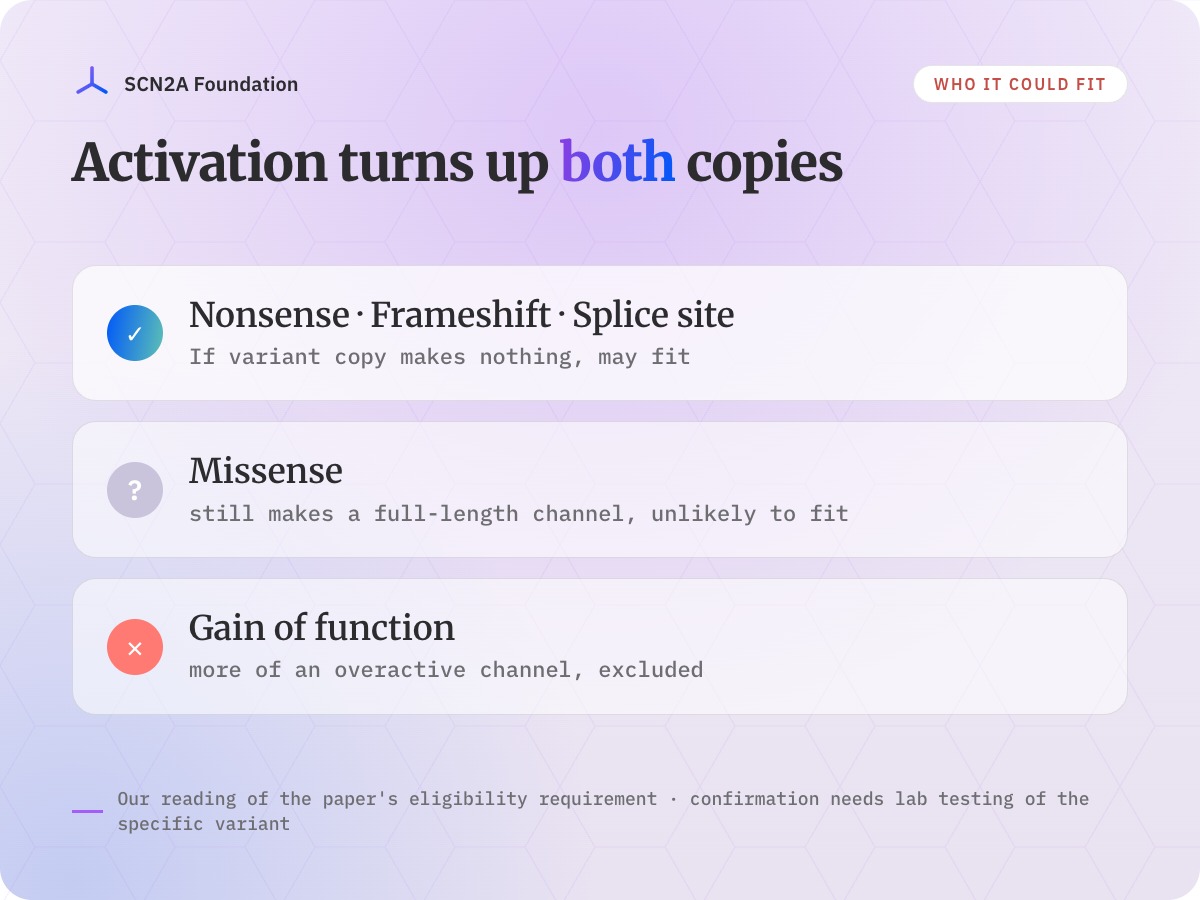
Unlikely to Fit: Missense Variants
A missense variant swaps one amino acid for another. The rest of the protein is built normally. The transcript is full-length. The protein is full-length. It folds, it reaches the cell membrane, and it forms a sodium channel.
The channel does not work correctly. Depending on the specific swap, it may open too slowly, close too quickly, carry less current, or sit in the wrong part of the neuron. That is why a missense variant can cause loss of function at the clinical level. The child has symptoms because the channel underperforms.
But the transcript itself is not non-functional. The cell reads it, builds the protein, and sends it to work. Nonsense-mediated decay does not touch it because there is no premature stop to detect.
This is the problem. CRISPR activation turns up both copies. If the variant copy still makes a full-length protein, turning it up makes more of that protein. For a missense variant that reduces channel function, the child now has more of a channel that does not work well. The net effect depends on exactly how the variant changes the protein, but the approach was not designed for this situation, and the authors exclude it from their eligibility statement.
Does Not Fit: Gain-of-Function Variants
Gain-of-function variants make the sodium channel overactive. The channel opens too easily, stays open too long, or both. Neurons fire when they should be quiet. In many cases, this causes seizures in the first weeks or months of life.
CRISPR activation increases how much NaV1.2 protein the cell makes. For a gain-of-function variant, that means more overactive channels. The treatment would worsen the problem.
This is not a gray area. Gain-of-function variants are excluded.
The Variant Name on the Report Is Not the Final Answer
The categories above are a starting point. They describe what usually happens with each variant type, not what always happens.
The exception is truncating variants that escape quality control. A truncating variant shortens the protein. Nonsense and frameshift variants are both truncating variants. Most of the time, nonsense-mediated decay catches the shortened message and destroys it.
But nonsense-mediated decay has a blind spot. It works by comparing the position of the premature stop to the positions where the transcript was spliced. If the premature stop falls in the last exon, or very close to the final splice junction, the system does not flag it. The shortened message survives. The cell builds a truncated protein from it.
A truncated protein is not the same as no protein. It may fold partially, reach the membrane, and interfere with normal channels. In that case, turning up the variant copy would produce more truncated protein, not more nothing. The eligibility requirement is not met even though the genetic report calls it a truncating variant.
That is why the authors wrote “it will be vital to confirm” rather than “it will be vital to check the variant type.” Confirmation means testing what the specific variant actually does in a cell.
The most direct test is to measure whether the variant copy produces a transcript. This can be done with a technique called RT-PCR, which detects and measures specific RNA messages in a cell. If the variant copy’s transcript is absent or present at very low levels, nonsense-mediated decay is working and the copy is silent. If the transcript is present at normal levels, the copy is still producing messages, and those messages may be making protein.
A second layer of testing checks for the protein itself. Western blotting can detect whether a truncated NaV1.2 protein is present. If it is, the question becomes whether it interferes with normal channel function, which requires electrophysiology, the direct measurement of electrical current through individual channels.
These are not bedside tests. They require a research laboratory, and in most cases they would be run on neurons grown from the child’s own cells (called iPSC-derived neurons, made by reprogramming a skin or blood sample). This kind of testing is not routine clinical care today, but it is the standard the authors point to when they say confirmation is required.
Not all loss-of-function variants behave the same way.
What Stands Between Here and a Clinical Trial
No CRISPR activation therapy has entered human clinical trials for any condition. The SCN2A program has been licensed to Regel Therapeutics, co-founded by Ahituv and Matharu, and it remains preclinical.
The authors listed what comes next: confirming each child’s variant produces a non-functional transcript, safety testing of the viral components, checking for unintended effects on other genes, testing in non-human primates, and settling the right dose. When the researchers checked whether the treatment accidentally activated other genes, SCN2A was the only sodium channel gene affected. That level of precision is exactly what a therapy like this needs.
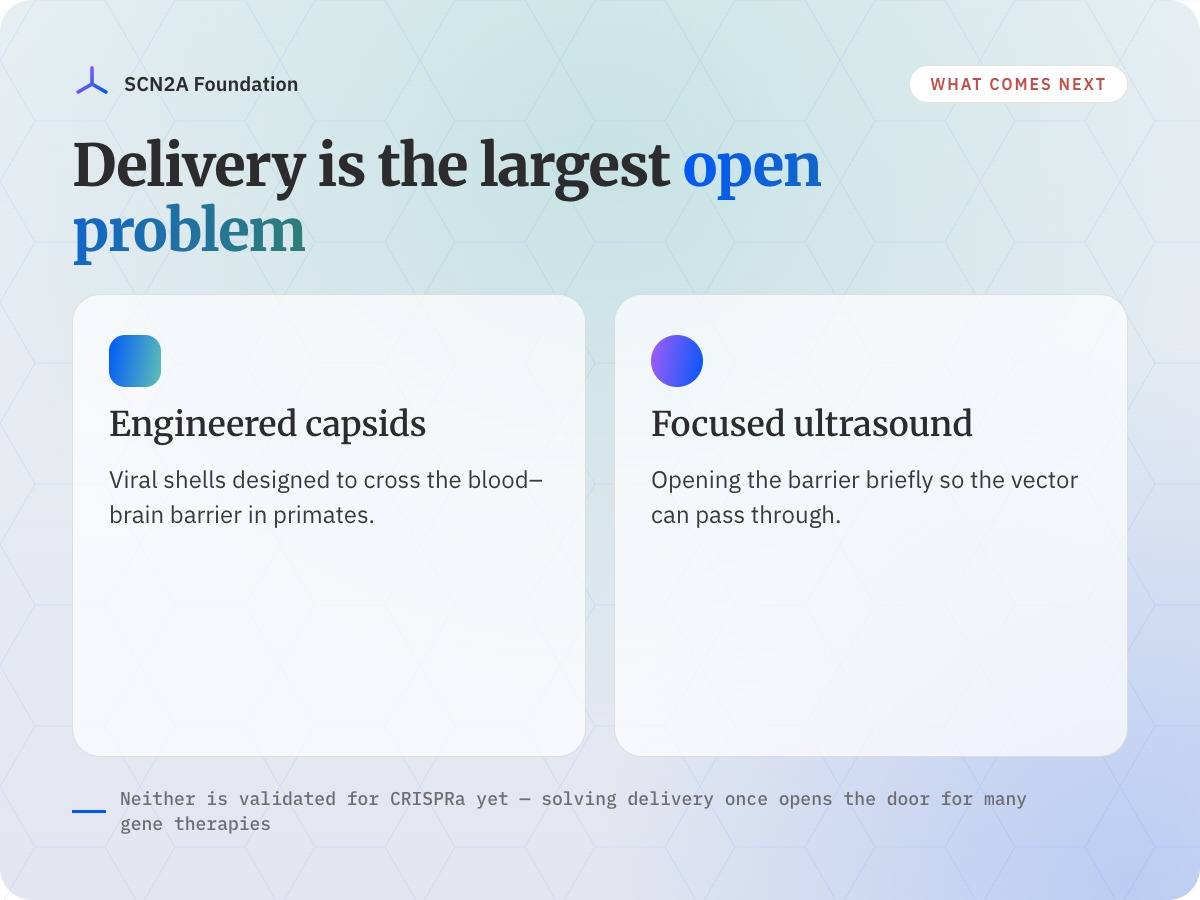
Delivery is the largest open problem. The vector used in this study works only in certain mouse strains. Getting the machinery into a human brain requires a different solution. The authors point to two active areas of research: engineered viral capsids designed to cross the blood-brain barrier in primates, and low-intensity focused ultrasound to open the barrier and let vectors through temporarily. Neither has been validated for CRISPRa delivery yet, but both are advancing quickly, and solving delivery for one gene therapy opens the door for many others, including this one.
Where We Go From Here
This research is preclinical. No child has received this treatment. But the path from here is clearer than it was two years ago. A single injection raised protein levels in mice, reduced seizure susceptibility, and held for over a year. The treatment activated only the target gene. And a company built by the scientists behind the work is now carrying it toward the clinic.
We’re tracking every program moving toward families. You can help build the data and community that make these therapies possible.
Add your family to the SCN2A WorldMap to connect with other families worldwide.
Join the SCN2A patient registry to contribute the data researchers need to design clinical trials.
If this work matters to you, please consider donating to help fund the research that moves us all forward.
References
- Tamura, S., Nelson, A.D., Spratt, P.W.E., et al. (2025). CRISPR activation for SCN2A-related neurodevelopmental disorders. Nature, 646(8086), 983–991. https://www.nature.com/articles/s41586-025-09522-w
- Gilbert, L.A., et al. (2013). CRISPR-mediated control of gene repression and activation. Cell, 154(2), 442–451. https://doi.org/10.1016/j.cell.2013.06.044
- Matharu, N., et al. (2019). CRISPR-mediated activation of a promoter or enhancer rescues obesity caused by haploinsufficiency. Science, 363(6424). https://www.science.org/doi/10.1126/science.aau0629
- Colasante, G., et al. (2020). dCas9-Based Scn1a Gene Activation Restores Inhibitory Interneuron Excitability and Attenuates Seizures in Dravet Syndrome Mice. Molecular Therapy, 28(1), 235–253. https://pmc.ncbi.nlm.nih.gov/articles/PMC6952031/
- Sanders, S.J., et al. (2018). Progress in Understanding and Treating SCN2A-Mediated Disorders. Trends in Neurosciences, 41(7), 442–456. https://pmc.ncbi.nlm.nih.gov/articles/PMC6015533/
- MedlinePlus. SCN2A gene. U.S. National Library of Medicine. https://medlineplus.gov/genetics/gene/scn2a/
- Regel Therapeutics. SCN2A Program. https://regeltherapeutics.com/news-articles/scn2a